Home · Learn · El Niño · El Niño basics and science
Thermocline and upwelling: the hidden ocean layer that drives El Niño
In short. Most El Niño maps show the sea surface. But the key change happens tens of metres down, at a boundary called the thermocline.
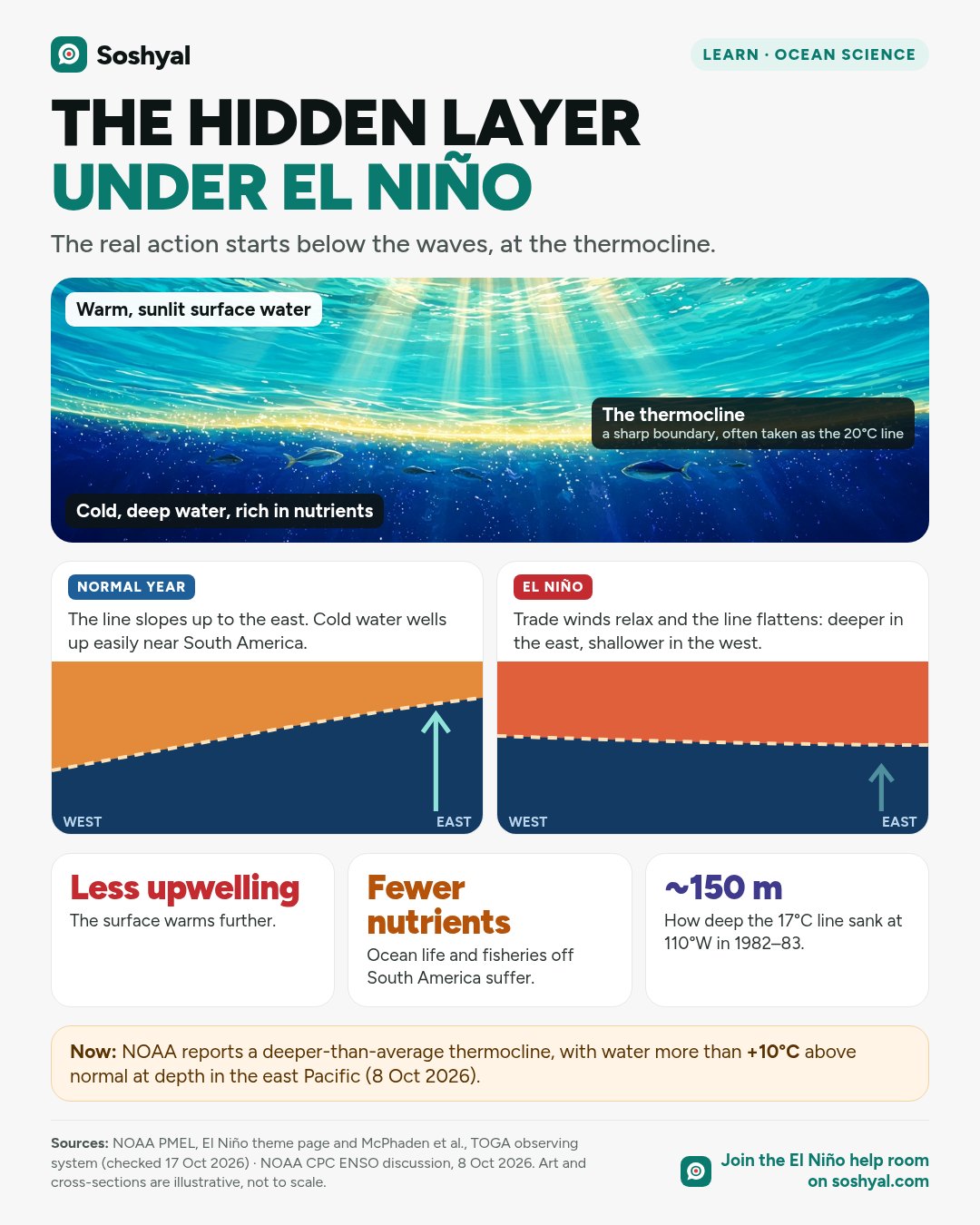
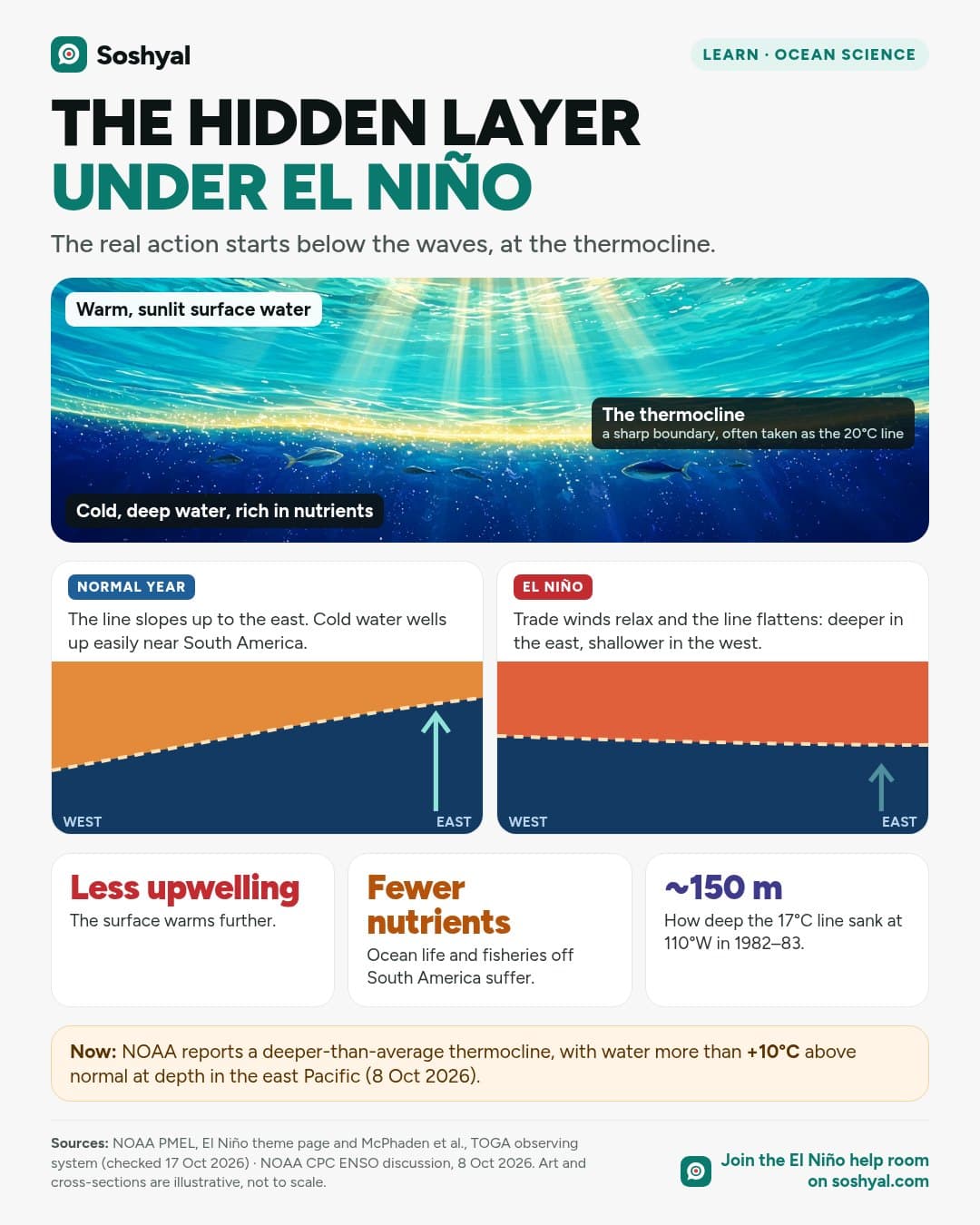
Most El Niño maps show the sea surface. But the key change happens tens of metres down, at a boundary called the thermocline.
What is the thermocline? It is the sharp boundary between warm, sunlit surface water and the cold water below. NOAA's Pacific Marine Environmental Laboratory (PMEL) often shows it as the depth of 20°C water.
In a normal year the trade winds pile warm water up in the west, so the thermocline is deep near Indonesia and shallow near South America. It slopes up towards the east. Because it is shallow there, winds can easily pull cold, nutrient-rich water up to the surface. This is upwelling (NOAA PMEL).
During El Niño the trade winds relax and the thermocline flattens: it sinks in the east and rises in the west. Upwelling then cools the surface much less, so the sea warms further, and fewer nutrients reach sunlit water. PMEL notes that in the 1982–83 El Niño the 17°C line at 110°W dropped to about 150 metres, and ocean life and commercial fisheries in the region declined sharply.
Right now. NOAA's 8 October 2026 update describes a deeper-than-average thermocline, with temperatures more than 10°C above average at depth in the eastern Pacific. That stored heat helps keep this El Niño going.
Join the El Niño help room on soshyal.com to ask questions and share what you see in your area.
What you can do
- Read the checked facts
- Share this with your family or building group
- Join the room to ask or offer help
Last checked 17 Oct 2026
Last checked: 17 October 2026. Forecasts can change; check the latest IMD, NOAA, WMO and BoM updates.
Sources
Pick your room
El Niño 2026: Learn & Help
What El Niño means for India, and a place to ask or offer help.
Always openJoinHyderabad Water Watch
Water-saving tips, leak reports and neighbour help in Hyderabad.
Always openJoinHeat Safety India
Heat warnings, cool spots and looking out for neighbours.
Always openJoinFarmers & El Niño
Farmers sharing rain updates, rabi tips and help.
Always openJoinKids Learn: El Niño
Parents and teachers explaining El Niño to kids. Room is for adults 18+.
Always openJoin