Home · Learn · El Niño · El Niño basics and science
Normal conditions: what a balanced Pacific looks like
In short. To understand El Niño, it helps to know what a normal year looks like across the tropical Pacific Ocean.
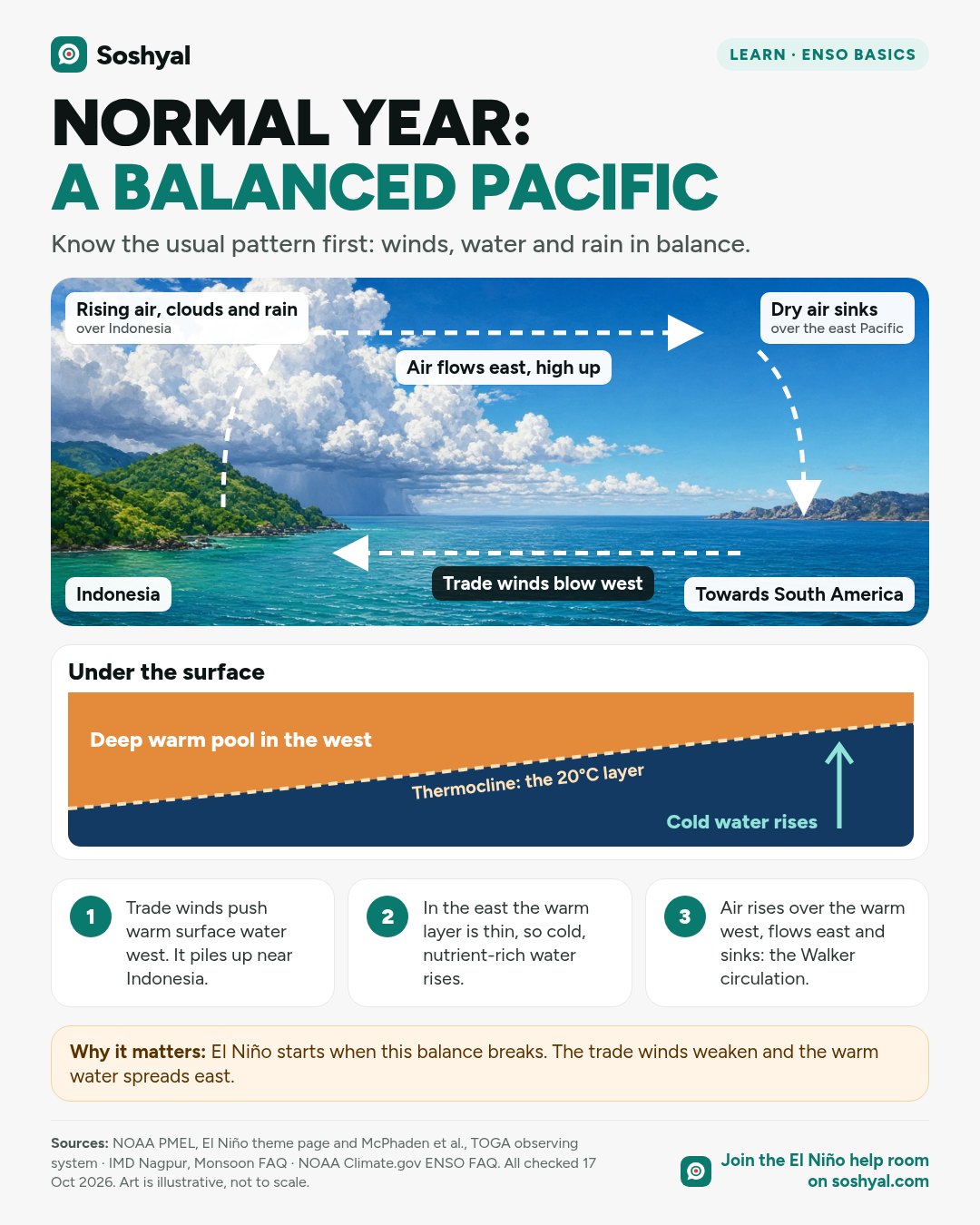
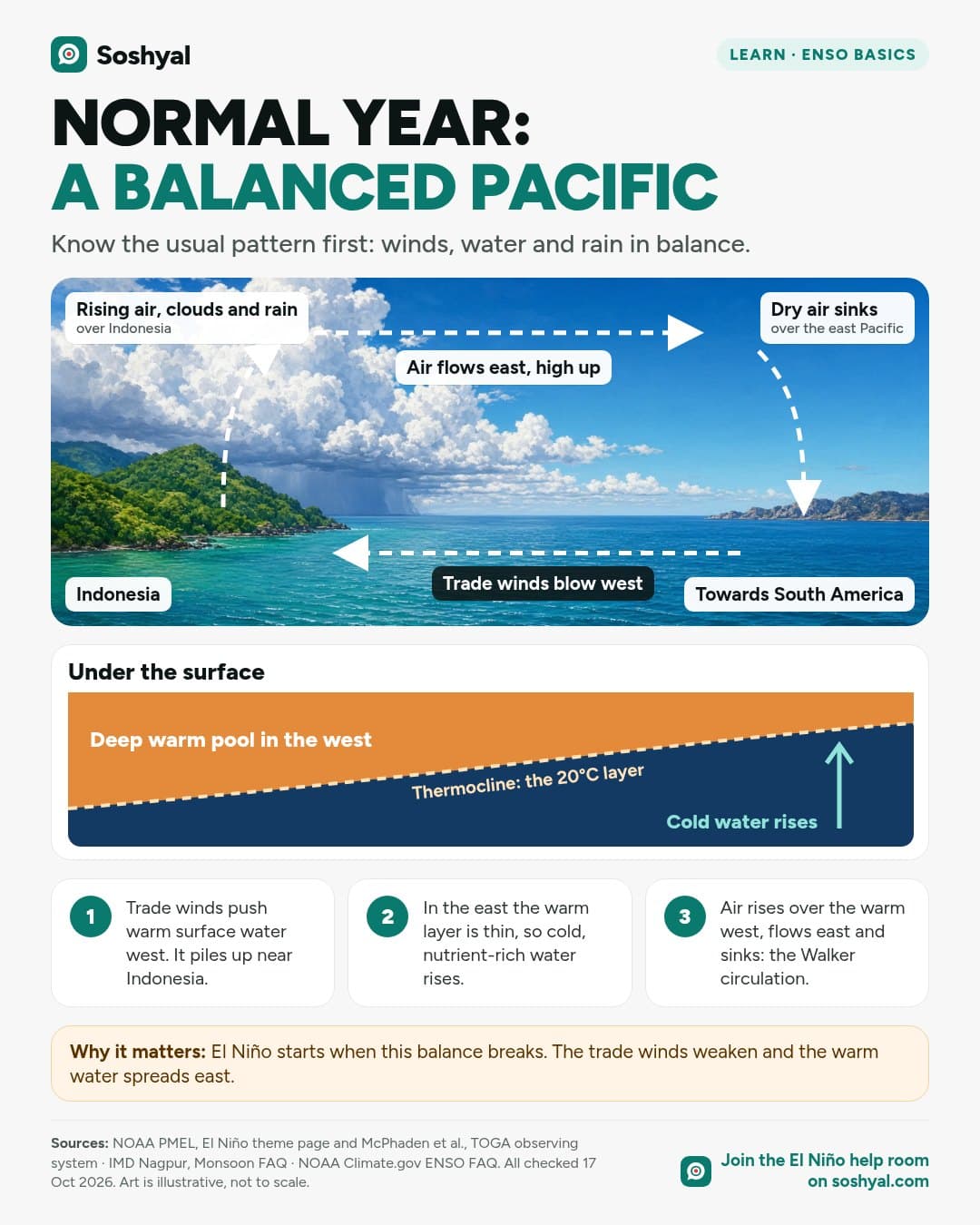
To understand El Niño, it helps to know what a normal year looks like across the tropical Pacific Ocean.
The winds. In a normal year, steady trade winds blow from east to west along the equator. They push warm surface water towards Indonesia, where it piles up into a deep "warm pool" (NOAA PMEL).
The ocean. Because warm water is pushed west, the warm layer near South America is thin. The boundary between warm surface water and cold deep water, called the thermocline (scientists often use the depth of 20°C water), slopes up towards the east. There, cold, nutrient-rich water rises to the surface. This is called upwelling, and it forms a "cold tongue" of cooler sea.
The air. Over the warm west, moist air rises, builds tall clouds and brings rain. High up, the air flows east and then sinks over the cooler east Pacific, where skies are drier. This loop is the Walker circulation. It is named after Sir Gilbert Walker, a former head of India's weather service, who studied the related pressure see-saw in the 1920s (IMD).
Why it matters for El Niño. El Niño begins when this balance breaks. The trade winds weaken, the warm water spreads east and the rain moves with it (NOAA Climate.gov). Knowing the normal pattern makes every El Niño map easier to read.
Join the El Niño help room on soshyal.com to ask questions and share what you see in your area.
What you can do
- Read the checked facts
- Share this with your family or building group
- Join the room to ask or offer help
Last checked 17 Oct 2026
Last checked: 17 October 2026. Forecasts can change; check the latest IMD, NOAA, WMO and BoM updates.
Sources
- NOAA PMEL, What is El Niño? · 17 Oct 2026
- McPhaden et al., The TOGA observing system, NOAA PMEL · 17 Oct 2026
- IMD Nagpur, Frequently Asked Questions on Monsoon · 17 Oct 2026
- NOAA Climate.gov, El Niño and La Niña: Frequently asked questions · 17 Oct 2026
Pick your room
El Niño 2026: Learn & Help
What El Niño means for India, and a place to ask or offer help.
Always openJoinHyderabad Water Watch
Water-saving tips, leak reports and neighbour help in Hyderabad.
Always openJoinHeat Safety India
Heat warnings, cool spots and looking out for neighbours.
Always openJoinFarmers & El Niño
Farmers sharing rain updates, rabi tips and help.
Always openJoinKids Learn: El Niño
Parents and teachers explaining El Niño to kids. Room is for adults 18+.
Always openJoin