Home · Learn · El Niño · Impact on India
Summer 2027 heat risk: the ‘decay year’ pattern explained
In short. You might think the danger is over once El Niño fades. For heat in India, the pattern can be the opposite.
You might think the danger is over once El Niño fades. For heat in India, the pattern can be the opposite.
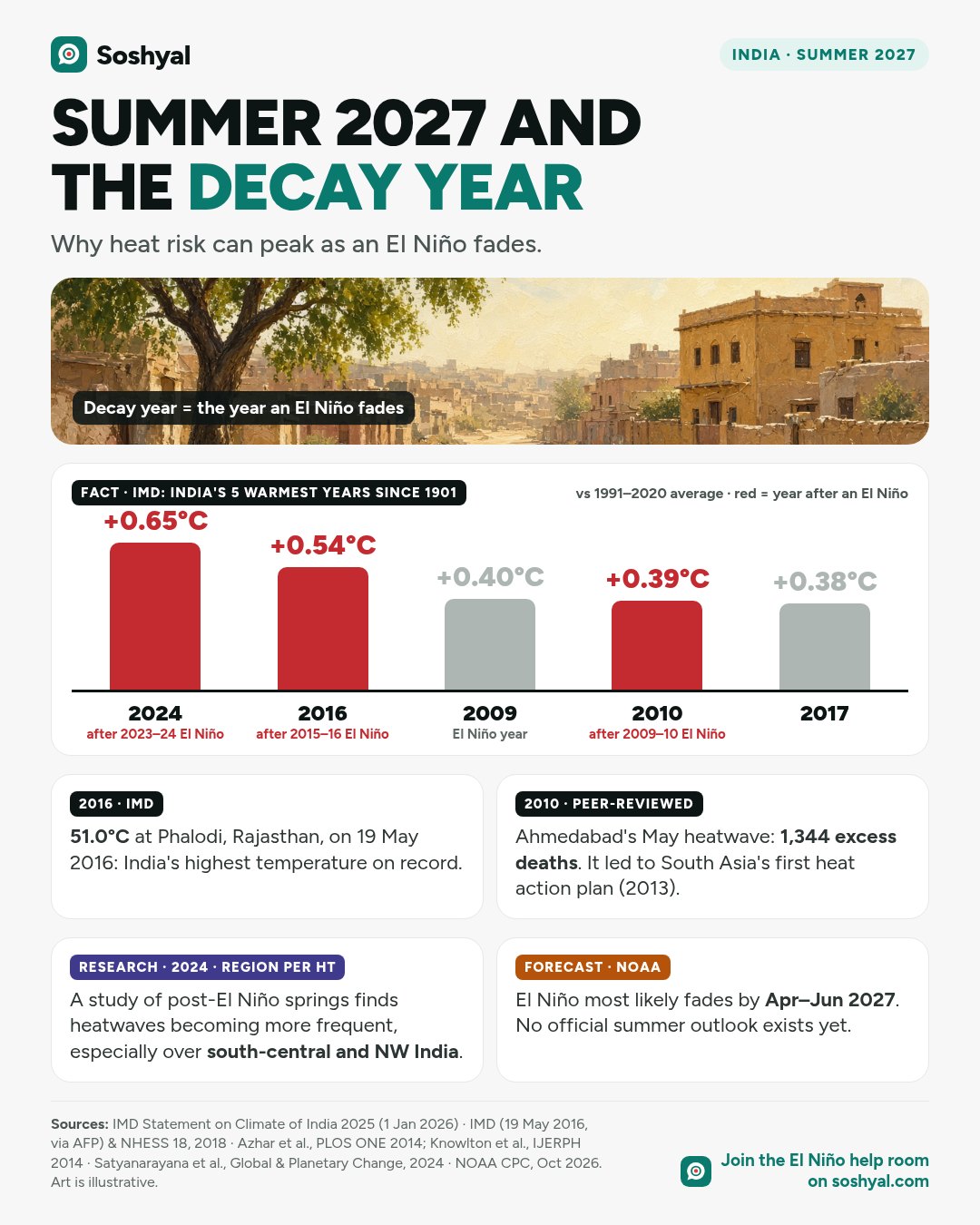
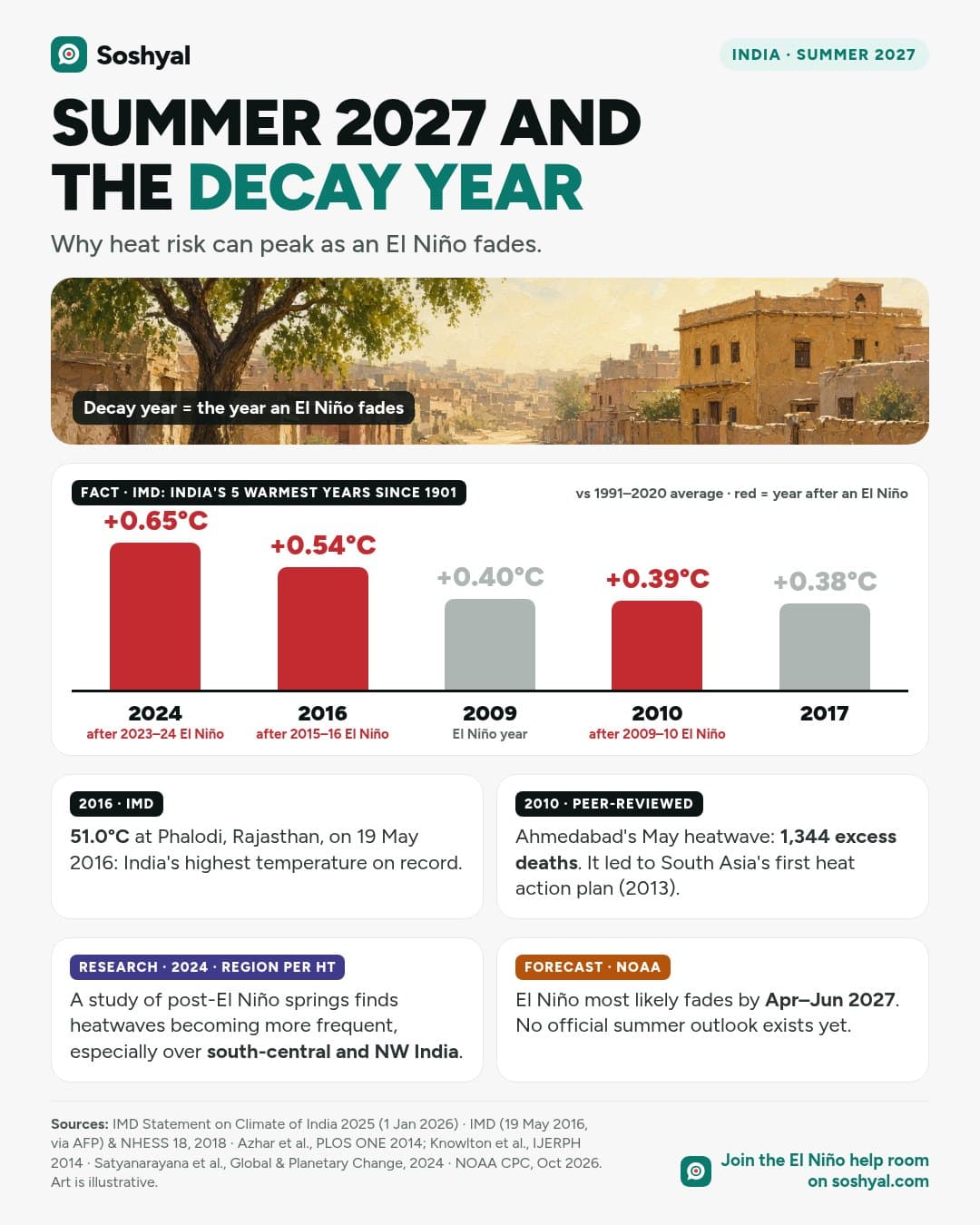
What is a decay year? It is the year in which an El Niño weakens and ends. NOAA's October outlook suggests this El Niño will most likely fade to neutral by April–June 2027, which overlaps with India's hottest months.
What IMD's records show. IMD's Statement on the Climate of India 2025 lists the five warmest years since 1901: 2024 (+0.65°C above the 1991–2020 average), 2016 (+0.54°C), 2009 (+0.40°C), 2010 (+0.39°C) and 2017 (+0.38°C). Three of them, 2024, 2016 and 2010, came straight after El Niño events.
Records in decay years.
- 2016: IMD reported 51.0°C at Phalodi, Rajasthan, on 19 May 2016, India's highest temperature on record.
- 2010: a peer-reviewed study (Azhar et al., PLOS ONE, 2014) found Ahmedabad's May 2010 heatwave was linked to 1,344 excess deaths. The city went on to launch South Asia's first heat action plan in 2013.
What research says. A 2024 study in Global and Planetary Change, "Increasing heat waves frequencies over India during post-El Niño spring and early summer seasons", examines exactly this pattern. As reported by Hindustan Times, it finds the sharpest rise over south-central and north-west India.
Important caveat. There is no official forecast for summer 2027 yet. A pattern is not a promise.
How to prepare. Find out whether your city or state has a heat action plan, learn the signs of heat illness, and plan shade and water for outdoor workers, elders and children.
Join the El Niño help room on soshyal.com to ask questions and share what you see in your area.
What you can do
- Read the checked facts
- Share this with your family or building group
- Join the room to ask or offer help
Last checked 17 Oct 2026
Last checked: 17 October 2026. Forecasts can change; check the latest IMD, NOAA, WMO and BoM updates.
Sources
- IMD, Statement on the Climate of India during 2025 (1 Jan 2026)
- IMD, Annual Climate Summary 2024 (15 Jan 2025)
- IMD director B.P. Yadav on Phalodi 51.0°C, via AFP/The Guardian (20 May 2016), ; van Oldenborgh et al., NHESS 18, 365 (2018), https://nhess.copernicus.org/articles/18/365/2018/
- Azhar et al., Heat-related mortality in India: excess all-cause mortality associated with the 2010 Ahmedabad heat wave, PLOS ONE (2014)
- Knowlton et al., Development and implementation of South Asia's first heat-health action plan in Ahmedabad, IJERPH (2014)
- Satyanarayana et al., Increasing heat waves frequencies over India during post-El Niño spring and early summer seasons, Global and Planetary Change (2024), (regional finding as reported by Hindustan Times, 4 Sep 2026)
- NOAA CPC, Official ENSO Probabilities (Oct 2026)
Pick your room
Heat Safety India
Heat warnings, cool spots and looking out for neighbours.
Always openJoinEl Niño 2026: Learn & Help
What El Niño means for India, and a place to ask or offer help.
Always openJoinHyderabad Water Watch
Water-saving tips, leak reports and neighbour help in Hyderabad.
Always openJoinFarmers & El Niño
Farmers sharing rain updates, rabi tips and help.
Always openJoinKids Learn: El Niño
Parents and teachers explaining El Niño to kids. Room is for adults 18+.
Always openJoin