Home · Learn · El Niño · Heat safety
Reading IMD heat warnings: green, yellow, orange and red
In short. When summer comes, IMD heat warnings appear on the news and on phones. Knowing what each colour means helps you act in time.
When summer comes, IMD heat warnings appear on the news and on phones. Knowing what each colour means helps you act in time.
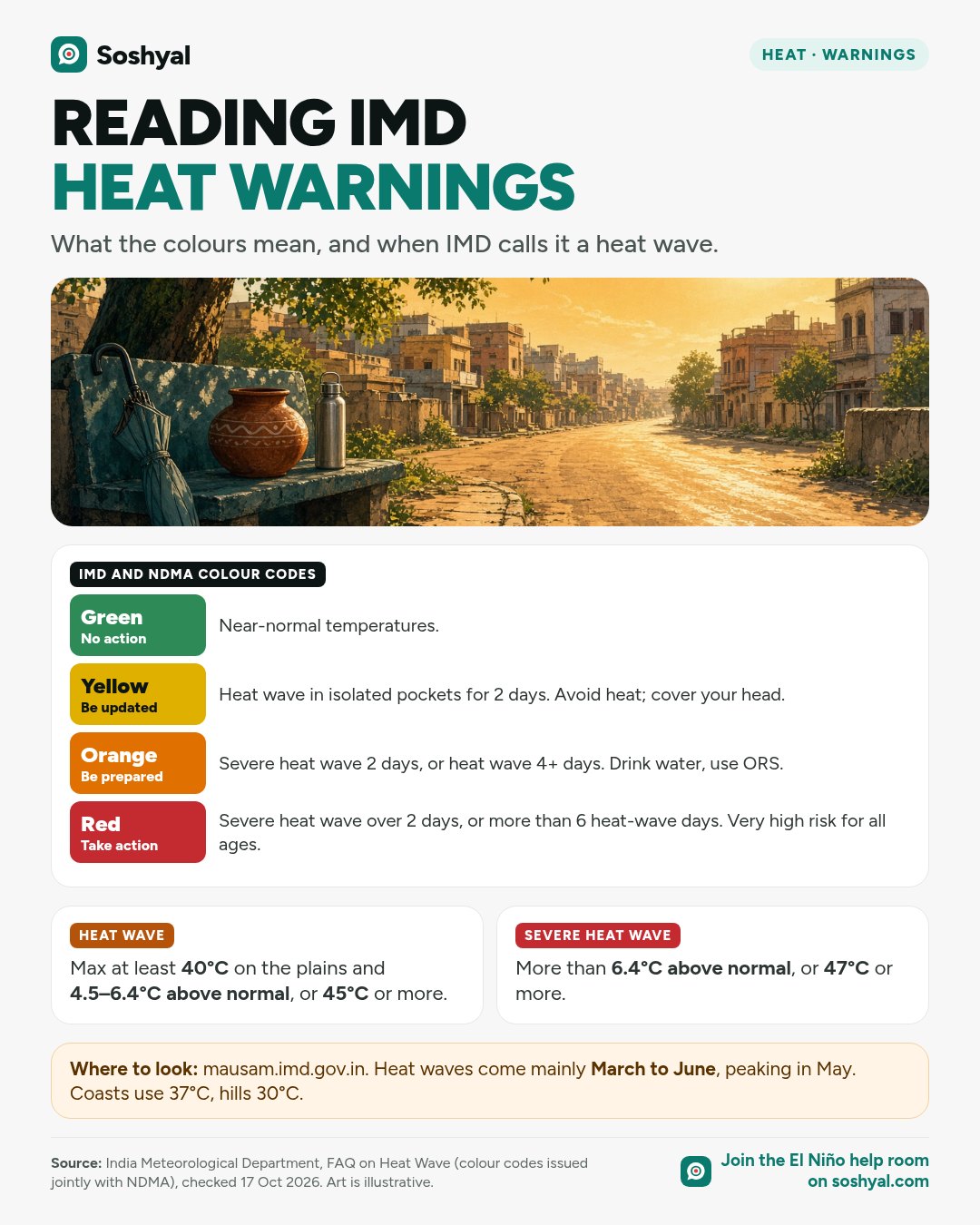
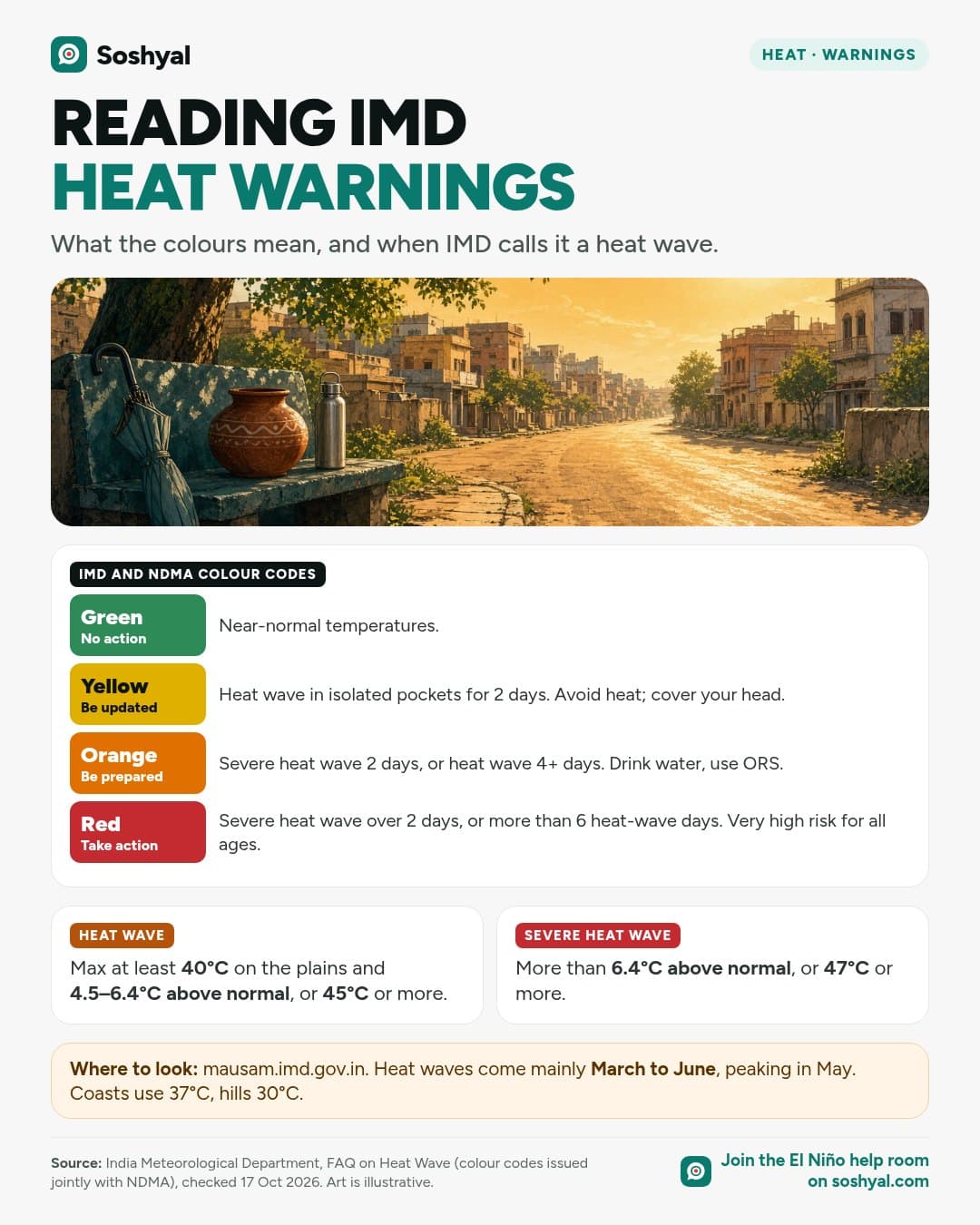
The colour codes. IMD issues impact-based heat warnings jointly with NDMA. Green means a normal day and no action. Yellow (be updated) means heat-wave conditions in isolated pockets for two days; heat is tolerable for most people but a moderate concern for vulnerable people such as infants, the elderly and those with chronic illness. Orange (be prepared) means a severe heat wave for two days, or a heat wave lasting four days or more; heat illness becomes more likely for people in the sun for long or doing heavy work. Red (take action) means a severe heat wave for more than two days, or more than six heat or severe heat-wave days in total; there is a very high likelihood of heat illness and heatstroke at all ages.
What counts as a heat wave. On the plains, a station's maximum must reach at least 40°C (30°C in hilly areas). It is a heat wave when that is 4.5 to 6.4°C above normal, and a severe heat wave when it is more than 6.4°C above normal. A maximum of 45°C or more is a heat wave, and 47°C or more a severe heat wave, regardless of normal. Coastal stations need 37°C or more with a departure of 4.5°C. The criteria must hold at two stations in a subdivision for two days in a row.
Where to look. IMD's website, mausam.imd.gov.in, and its daily bulletins. Heat waves occur mainly from March to June, peaking in May.
Join the El Niño help room on soshyal.com to ask questions and share what you see in your area.
What you can do
- Read the checked facts
- Share this with your family or building group
- Join the room to ask or offer help
Last checked 17 Oct 2026
Last checked: 17 October 2026. Forecasts can change; check the latest IMD, NOAA, WMO and BoM updates.
Sources
Pick your room
Heat Safety India
Heat warnings, cool spots and looking out for neighbours.
Always openJoinEl Niño 2026: Learn & Help
What El Niño means for India, and a place to ask or offer help.
Always openJoinHyderabad Water Watch
Water-saving tips, leak reports and neighbour help in Hyderabad.
Always openJoinFarmers & El Niño
Farmers sharing rain updates, rabi tips and help.
Always openJoinKids Learn: El Niño
Parents and teachers explaining El Niño to kids. Room is for adults 18+.
Always openJoin